Review of Evolution by Primitivity

Band: Primitivity
Album: Evolution
Release Date: 16 October 2013
Buy from CD Baby (digital) for $9.99: Here

Cover of Evolution by Primitivity

Did you know the DC area has its own heavy metal cello based group? You may not be familiar with Primitivity since they, at least so far, haven’t played many of the venues we tend to find metal bands at. They just released an album of originals that is, well, I’ll let DCHM writer Tal’s review speak for us on this. You can also check out her personal blog here, which includes a review of a recent Primitivity concert she attended. And as always there’s a couple songs you can stream at the bottom of this post so give the band a listen as you read the following review.

Primitivity, a quartet of three cellists and a percussionist led by Loren Westbrook-Fritts, debuted three years ago with Plays Megadeth for Cello – an obvious nod to Apocalyptica’s Plays Metallica by Four Cellos. Primitivity’s new album, Evolution, which is made up entirely of original compositions, demonstrates that this group of University of Maryland grads is far from a copy of that pioneering cello rock band. On Evolution, Primitivity blends the flavors of heavy metal and classical cello music in a way that is all their own, and will appeal to metal heads and classical music fans alike.

When I first heard Primitivity’s music, I was immediately struck by how guitar-like the sound was. The first thing I heard, through a sample track on their website, were the opening “riffs” of “Sacrifice” and then “Primitivity,” and that was just what they sounded like – guitar riffs. “Sacrifice” starts off with some energetic, slightly thrashy riffs, that you can just figure out are cellos if you really think about it. “Primitivity” begins with hammering NWOBHM-ish riffs – and then about half a minute in a clean cello melody comes in, giving the music the feel of symphonic metal.

I was hooked right away by the cello “guitar riffs”, but as I listened to the rest of the album, I realized that Primitivity uses their cellos to imitate all sorts of guitar sounds. Not just riffs – there are also shreddy solos, complete with distortion and “guitar squeals,” eked out by driving the cello to the very top of its range and pizzicato segments that sound very like acoustic guitar (pizzicato notes are plucked with the fingers). I had the opportunity to see the band live at their CD release show on October 16 at the Mansion at Strathmore, and in a live environment they sounded more like cellos – but even live, the lowest parts still sounded surprisingly like bass guitar riffs.

Not only that, but the trio of cellos backed up by drums manages to recreate pretty much the whole sound of metal music, up to and including “vocals.” Primitivity is purely instrumental, with no vocals, yet in many songs the cello parts (that is, the parts that actually sound like cello) play the role of vocals. This is quite appropriate, considering that the cello is considered the instrument that most closely mimics the human voice. I first noticed it in the song “Forgiven” – when the drums, the melody and the background parts all came together at the climax of the song, it suddenly sounded like a rock ballad with the lead cello delivering the anguished vocals. There are a few other songs where I had this impression, too, most notably “Transcendence,” where the leading cello seems to sing over a chugging “bass.”

And of course, I can’t leave out the drumming. The band wouldn’t sound metal without it, after all. The percussion is nothing super fancy, leaving the spotlight of complexity on the cellos, but it does give the music the familiar rhythm and kick of metal, and is delivered crisply and energetically. I’ve heard it said that percussion is the backbone of a metal band, and that’s what the drummer creates here – a solid backbone for the cellos to build on.

Without a doubt, my favorite song on Evolution is “Convergence.” It begins with a heavy intro of moderately paced riffs, which quiet momentarily as a lovely melody begins. Soon the riffs start up again, and the fusion of riffs and melody will touch the heart of anyone who enjoys sorrowful melodic metal. Aggressive riffs occasionally come to the fore only to yield the stage to the melody again, and then about midway through they come together in a perfect fusion of heaviness and beauty that gives me chills. After that guitar sounds take over for a bit, with what sounds like twin lead “guitars” and then a short shreddy “solo” before the melody soars over the riffs again. I catch myself playing air guitar, laugh and start playing air cello instead.

As a fan of guitar (and cello) riffs, I most enjoyed the energetic, riffy parts of the other songs as well. The rocking, guitar-like intro to “Primitivity” was one of the things that first drew me to the band. Then a sweeping cello melody soars over the riffs, the smoothness and vivacity of the melody contrasting with the moderate staccato marching of the lower riffs. (Staccato notes are short, fast, percussive notes made with the bow.) The first song on the album, “Sacrifice,” also has a strong guitar-riff sound, which is almost thrashy; the melody actually falls in the background to the riffs for most of the song. The way the cellos mimic the sound of electric guitars in these first two songs is pretty amazing; there are parts where if you didn’t know better, you might actually think there was a bass guitar riffing away with a cello playing the melody. “Psycho Logic” and the short, intro-like “Overdrive” right before it are probably the most energetic and metallic songs on the album, with some more rocking riffs in “Overdrive” and very heavy, almost thrashy riffs opening “Psycho Logic.” “Psycho Logic” is carried by a jaunty cello melody, but features a lot of, shall we say, weirdness, in keeping with its name – frantic high-pitched “shredding,” very dark and harsh grinding moments that sound impossible for an acoustic instrument to produce – along with ever faster takes on the melody and some furious “bass” riffing. It’s undoubtedly the most powerful metallic song on the album. “Revival” also gets furious near the end, although the beginning is very classical-sounding, with pizzicato that sounds almost like acoustic guitar, a flowing melody and a background of short but obviously cello-sounding notes backing it up. The drums and the “riffs” don’t come in until nearly two minutes in, when the background starts to pick up a bit of distorted, heavy sound. Three quarters through the song, it suddenly changes character entirely, with racing riffs and a feverish melody that dissolves into scratchy high-pitched sounds, to end on a fast note. “Emergence” also features some solid riffing, although the cello sound shines through even in the lower notes for most of the song. It also has a very sweet melody that soars over the infectious momentum of the riffs, and sometimes takes a backseat to more complex guitar-like work, including some shreddy moments.

These songs alternate with slower songs, which I did not dig as much at first, but they started to grow on me as I listened to them more closely. Even these slower songs have energy – they feature riffy backgrounds and shreddy solos, intense climaxes and lovely melodies. “Ascend,” a song which Loren described at the show as an attempt at “simple” songwriting, is dominated by long sweeping cello notes. It keeps my attention more with the catchy riffs in the background and some thin, high sounds that eventually resolve into a short “solo,” however. “Forgiven” starts out very slow, with an almost synthy sound that is encouraged by the distant, minimal drums. Long, sad notes eventually give way to an achingly beautiful melody, and finally about two minutes in the “guitar riffs” and drums pick up. Finally things come together in the climax where I noticed the leading cello delivering the “vocal line.” Unfortunately, this energy is quickly dropped for a quiet, slow take on the melody over distant drums; fortunately, the quiet interlude is quickly ended by a “solo” and then the song intensifies again. “Transcendence,” as the slowest song on the album, is sort of a shock after the fast and energetic “Psycho Logic.” But it’s not all long flowing notes – there’s some pizzicato and “bass guitar” notes as well, which add texture and intensity. Like in “Forgiven,” things eventually come together and the cello delivers emotional “vocals” while the “bass” chugs away in the background and the drums keep slow but insistent time. This time the intensity is not dropped but keeps going until a crescendo near the end. The album also closes on a slow note with “Prayer,” which the band played “acoustic” when I saw them live. I didn’t understand what they meant by that at first – weren’t all the instruments acoustic anyway? But I think what they did was to turn off their speakers and distortion, and let the cellos speak for themselves, à la chamber music. Unlike the other slow songs, this one is devoid of any riffing in the background, and the percussion is restrained to some barely audible thumps, metallic clicks and some sort of shaker. It’s a beautiful and relaxing end to the album, and although I found my attention wandering a bit, the frequent changes in tempo and intensity drew me back.

I was very impressed by the album. It’s remarkably heavy and metal, while at the same time not losing sight of the essence of the cello. This band is not as aggressive as Apocalyptica – when I saw Primitivity live, I didn’t experience that terror of them destroying their instruments that Apocalyptica’s take on Metallica inspires in me – but Loren Westbrook-Fritts and Primitivity capture the sound and the spirit of heavy metal in a way that’s more in tune with the classical background of the cello. They don’t just use the cello to mimic the sounds of electric-guitar-based heavy metal, but create a mix of classical and heavy metal, using the natural sound of the cello, the ability of the cello to mimic the guitar as well as the voice, and the unique sounds somewhere in between to express themselves in an unusual way that is both headbang-worthy heavy and classically beautiful.

Review of Akris’s Self-Titled Album

Band: Akris
Album: Akris
Release Date: 24 September 2013
Record Label: Domestic Genocide Records
Buy from Bandcamp (digital) for $9.99: Here
Buy from Blue Collar Distro (CD) for $9.99: Here

Cover of s/t Akris release

DCHM album reviewer Grimy Grant gives us another album review, this time for the self titled release by Northern Virginia natives Akris. Usually I embed a couple of songs for you to listen to at the end of the post but the only place I’ve been able to find their music streaming is here at the Obelisk where you can stream the entire album. Try opening it in another tab and give it a listen while you read Grimy Grant’s review below.

Blasting their intense bass riffs out of Frederick, Virginia, Akris has released a full-length for 2013 named after themselves: Akris. Helena Goldberg performs the bass and vocals – you can see her on the Akris band page giving the mic due punishment. What comes through the headphones in this album is a bit of Burning Witch via riot grrrl – a kind of noisy, punk-y, jazz-y rock that “creates an avalanche of bass and drums, with a layer of celestial noise on top” (from their own bio). Metal Archives lists them as stoner/sludge metal but I feel that they strive for way more than just that. The fact that they have different “multi-instrumentalist[s] and noise provocateur[s]” in addition to a drummer, Sam Lohman, is a testament to their striving to be more than just drum-and-bass sludge metal. As further proof of their eclectic roots, they are listed under their Bandcamp as “noise rock”, “hardcore punk”, and “blues”, all of which are comparable to Akris’ sound but also different.

As cool as that may be, the experimental, compositional music of this album was hard for me to enjoy. Akris leaves a weird taste in my mouth – not a bad taste, just weird enough to not make me want to go back too often. The sound of Akris to me comes off as if they rushed the release of the album, resulting in a lot of technical glitches. “Fighter Pilot”, the opening track, starts with about 5 seconds of dead space followed by some confusing bass notes that changed the pace of the song several times. It may have been intentional but comes off as amatuer. That’s not necessarily a bad thing – at times in the album I enjoyed the fuzziness of the songs – but it does cause some songs to leave a funky taste in the mouth.

The fuzzy, clunky bass is a kind of ode to punk and riot grrrl music. I mention riot grrrl only because Goldberg’s vocals remind me of Bikini Kill’s Kathleen Hanna a bit. It also resonates similarly to Kylesa’s guitarist-singer Laura Pleasants. Goldberg’s voice alternates between lullaby-like harmonies and screaming on all of the tracks. Even so, while it sounds heavy – very heavy, in fact – the guitar riffs tend to be repetitive by the third or fourth track. Akris does better overall in the vocals department. Goldberg’s voice stays with me after every song as a beautiful but deadly thing, both harsh and melodic. In “Fighter Pilot”, after the bass settles down and her voice comes through clearer, it makes the song enjoyable, or at least easier to wrap my brain around.

Akris definitely does the job right for a sludge band by being utterly depressing despite having some rough edges. Every song, while ignoring the context, is a bummer. There’s a fascination with the spiritual and other-worldly going on, too. An example of this is in the track “Row of Lights”. Goldberg sings of how she “Went to the mountain/ To find my escape” which resulted in her looking into the sky and the moving stars. The imagery fits more with a sludge song and I liked the bass breakdowns despite it being a bit similar to the other songs. As in much of the album, there is a balance between the fierceness of Goldberg’s voice and the slowness of the bass. “Row of Lights” keeps that crazy funeral march of bass and drums just enough to keep my heart from racing too much. “Riverbed” creates a funeral bass riff coupled with a dual harmony from Goldberg. It’s a kind of darkened farewell song talking about how her “heart is broken, beneath the riverbed” followed by Goldberg screaming “what happened to us?/ Why?” in a kind of frustrated cry to the dark river she’s beneath. Despite the clunky bass it has a way of blotting out any happiness in the room and drives home its message. The unusual harmony and composition pay off in these songs well.

The flipside of the experimental noise is that it sometimes hurts the songs. The following song after “Riverbed”, “Vomit Within” has disjointed harmony along with some stranger lyrics that I wasn’t able to make too much sense of: “There is a place inside my head/ That opens up when I am dead” followed by mentions of a shadowy figure. Piecing together how the lyrics of this song play with the rest of the “Vomit Within” caused some head scratching. Is the opening and the “shadow” that Goldberg sings about what we’re vomiting into? The metal name of the song just clashes too much with the sweet singing for it to make sense for me. It’s also hard to follow at about four minutes into the song when a male voice joins her (possibly a member of Admiral Browning) and the song gets weirder and more disharmonious. I love weird stuff, don’t get me wrong, but this just rubbed me the wrong way. All the parts were there for a great song like in “Riverbed” but they just didn’t pace well and it sounds unfinished.

Akris would be a great live band and I’d love to see them perform. In the studio, there is too much thumping, rusty Sunn amp bass distracting me from the rest of the songs. There are moments I found myself nodding to the rhythm though, and I feel that the technical glitches would go forgiven in a live setting, particularly in a DIY venue. At Hole in the Sky, Corpse Fortress, or Girl Cave there were some great bands that took the experimental route. At those shows I remember descending into each house’s basement, someone turning the lights off, and hearing some blasting, out of this world noise. Those are happy memories and I feel transported to those basements when I listen to Akris. I don’t remember anyone, including me, caring about glitches or the content of songs – it was more about the moment. Time has made me a grown-ass man now so maybe that’s my problem with this (feel free to digi-hurl old man jokes/rotten tomatoes at my Twitter handle @jgrantd – I don’t get a lot of traffic on Twitter as it is). Akris aims at a higher goal of doing something compositional and creative with their work – something that I gather from their band bio on their page. While it’s hard to get into at times I still like how they are trying something new. And Akris should be commended for their bravery in doing the unusual without being afraid of occasionally sounding off.

Review of Alma de Guerrero by Metanium

Band: Metanium
Album: Alma de Guerrero
Release Date: 19 September 2013
Buy from iTunes (digital) for $9.90: Here
Buy from CD Baby (digital) for $9.99: Here

Cover of Alma de Guerrero by Metanium

Tal is back with her second album review for DCHM and it marks a first on the site. Specifically, this is the first time we’ve reviewed a non-English album on the site. Alma de Guerrero by DC locals Metanium is, except for an alternate version of one track, entirely in Spanish. As always you can stream a few songs from it at the end of this review and you can also find more of Tal’s writing on her regular blog here.

I first became acquainted with Metanium’s music when I saw them open for Spanish folk metal band Mago de Oz in May. I really enjoyed Metanium’s set – a groovy mix of heavy metal right on the edge of power metal, with a cover of Helloween’s “I Want Out” that the singer delivered effortlessly. I wasn’t able to attend their album release party on September 19th, but I was looking forward to hearing the new release, Alma de Guererro, hoping for more heavy metal and Helloween-esque goodness.

Alma de Guererro (Soul of a Warrior) is a solid, enjoyable album, and pretty ambitious, too, reaching for the heights of the vocalist’s range and striving for hard-hitting heavy metal power. It has some really cool moments. But in contrast to the singer’s breezy take on Helloween at their show in May, here he frequently sounds strained. The recording quality is also rather low, which detracts a little from the ability to enjoy the guitar goodness – but for an underground, self-produced album, it’s a pretty good effort. The album cover and booklet, by contrast, are very professional and nicely designed. The digital design of a horned skull reflects the aggressive and (mostly) straightforward heavy metal direction of their music. Inside the booklet, one finds quality photos of the band and a simple but effective layout for song lyrics and the band’s thank yous.

The first song, “Veneno Mortal” (“Deadly Venom”), is a solid heavy metal track. It starts out a bit low key, but the random shreddy guitar bits scattered throughout the first two verses keep it interesting. After ending the second verse with a wail, the pace picks up, galloping for a few moments before settling into an aggressive NWOBHM sound. Toward the end is a fun segment where the drums and guitar thrash furiously for a couple seconds. The song provides a good taste of what’s to come on the album – solid heavy metal riffs, unfortunately a little obscured by the fuzzy production, gritty vocals with some wails thrown in, and random moments of amazing inspiration.

The title track, “Alma de Guerrero” (“Soul of a Warrior”) is also very strong. Starting off with a dramatic intro, epic guitar strains and a nice clear wail, it seems destined to be a thundering heavy metal attack. The vocals are quite powerful and gritty, although the singer seems to lose control a little at the end of the verses. The song urges the listener – the metalhead – to fight on in the face of evil, to keep pressing forward confidently, never to look back or give in to weakness; and the guitars and the strong vocals pack the energy the theme needs.

The album also includes an English version of this song which I didn’t enjoy as much. Some of the lyrics sound far too simple in English; the Spanish version is a little more poetic. For instance, the second verse of the song:

En este mundo, tienes que luchar
Siempre adelante tienes caminar
Con pasos firmes, y sin mirar atrás
Mantente fuerte, y sin debilidad

Vocalist Marvin Serrano, who wrote the lyrics, has translated this almost word for word:

In this world you must learn to fight
Always look forward when you’re walking down the path
So keep your head up and remember don’t look back
Remain strong and don’t ever give up

It’s still a great message, and conveys the literal meaning of the Spanish lyrics pretty closely, but in translation, especially of evocative works such as song lyrics, capturing the feeling and rhythm of the original is just as important as the literal meaning – and this translation is a little lacking in that department. Still, including an accurately translated English version of the title track is a nice touch for any listeners who don’t understand Spanish.

The two versions do differ slightly in more than just language. The Spanish version is sung solely by the vocalist, whereas the English version includes gang vocals in the chorus which sound a little disorganized. On the other hand, the verses sound a bit better on the English version.

My favorite song on the album is undoubtedly “Perdiendo el Control” (“Losing Control”), and I think it’s their most solid piece as well. It’s fast-paced, with strong, aggressive vocals throughout, and has some unusual guitar work for this genre – a thick, very distorted tone, with segments of buzzy tremolo picking and racing drums that have quite a black metal feel. Ironically, the song is called “Losing Control,” yet the vocalist seems much more in control of his vocals in this song than in some others.

The rest of the songs aren’t as memorable, though they do have their cool moments. “Al Filo del Metal” (“At the Edge of Metal”) is an old school heavy metal song with a decent rocking energy, but didn’t really hold my attention. “La Marcha Vikinga” (“The Viking March”) is another decent, moderately-paced song with a few snatches of shreddy guitar. The ballad, “Hace Mucho Tiempo” (“It’s Been a Long Time”) starts off nicely with an acoustic intro and then some beautifully mournful electric guitar, but the singer’s gritty vocals seem a little rough for this song at first, while his clean vocals on the agonized chorus are a bit weak, wavering as he tries to sustain notes. As the song goes on, though, the forceful singing style seems more appropriate, conveying the intensity of the persona’s grief and loneliness. “Victimas de la Religión” (“Victims of Religion”) starts off rather monotonous and plodding, but soon picks up the pace with a bit of a thrash vibe. Admittedly the dangerous-sounding bridge, about halfway through, is pretty ear-grabbing, as is the ending where the singer insists, “No seas victima de esta religión” (“Don’t be a victim of this religion”) over more of those dark and intense tremolo-ish riffs. “Sangra el Corazón” (“Bleed the Heart”) is notable for its polka rhythm, which makes it a fun song, in spite of the repetitive lyrics (several songs on the album suffer from those). The beginning of “Sangra el Corazón” is also the only song where I could actually hear the keyboard – if I hadn’t seen the keyboardist’s picture in the booklet, I would probably not even have known the band has one.

Besides the English version of “Alma de Guerrero,” the album also includes another bonus track, a half-acoustic alternate version of “Veneno Mortal.” I’m not a fan of acoustic versions of metal songs in general, since they usually lack the punch of the electric versions, so I was relieved when, about a minute and a half in, the electric guitar and drums started to pick up. About two thirds through, the same thrashy heavy metal vibe as in the first track took hold – so much for an acoustic version. I prefer the sound of original song, but hey, some people may enjoy the acoustic part.

I was surprised that the high-pitched and clean vocals on the album sounded so forced, compared to my fond memories of the singer’s wails at the show in May, and a little disappointed at the low production. The latter is perhaps to be expected for an underground album, though. As for the former, it doesn’t take away too much from my enjoyment of the album, since the aggressive vocals are still very strong, and there are some solid riffs to back it up as well as some flourishes of brilliance. I’ll be following these guys with interest to see how they progress on their next album.

Perdiendo el Control:

Veneno Mortal:

Review of Galaxia Infinitum by Grethor

Band: Grethor
Album: Galaxia Infinitum
Release Date: 16 August 2013
Buy from Bandcamp for $4: Here

Cover of Galaxia Infinitum by Grethor

Grimy Grant is back with another album review for DCHeavyMetal.com. This time he’s reviewing the new EP by Northern Virginia death metal band Grethor. Give it a read and be sure to give a listen to one of the songs at the bottom of this post.

Back in college, I took a survey course in Science Fiction. The professor, being an admittedly avid weirdo and Sci-Fi geek, demonstrated how you can split the genre of Sci-Fi into two groups: Star Wars-esque Sci-Fi and Star Trek-esque Sci-Fi. Star Wars refers to all the campy, unbelievable stories that hold only a little grip on reality (Think Predator, Stargate, or any SyFy channel original movie). Star Trek, on the other hand, was a show dedicated to “real” science, even if it meant fringe science. In other words, everything in “hard” Sci-Fi can be defended or explained by your physicist friends. Hard Sci-Fi, then, can be understood to worship logical reasoning above everything else.

My point is, Grethor is Star Trek. Even the name “Grethor” refers to the Star Trek Universe: it’s the Klingon word for Hell (i.e. Gre’Thor). Their new five-track EP, Galaxia Infinitum, solidifies their footing in the science fiction world but also proves that hard sci-fi can be curiously eerie and terrifying at the same time. Space by itself is a frightening concept as brought to mind in the album’s intro where we hear the astrophysicist Neil Dygrasse Tyson talking about “the importance of looking up”:

“Looking up … is the most humbling thing you can do … to contemplate the cosmos”

This is soon followed by the sounds of a spaceship crashing and exploding followed by the roars of some futuristic animal ready to tear us apart. It felt as if Grethor wanted me to learn a bit about the importance of physics and then leave me in the bleak yet gorgeous void as shown on the album art.

That sense of being lost didn’t last long. The first song, “Anomoly X”, set the tone and the message for the rest of the album in my mind. After a slow intro, singer Marcus Lawrence preaches the word of astronomy: “We look to the skies; Inward we look for the vastness of connection”. Marcus begs us to give up the hope of “false exhalations” that mankind comes from godhood. We are simple creatures making vague notions of what is real until we “choose the gift of enlightenment” and become truly free in knowing our part in the universe. It’s definitely a humbling message that repeats back the quote from the intro.

Good death metal often looks under the skin directly into the vilest, goriest, most unspeakable parts of humanity. In Galaxia humans are ugliest when they reject science. “Hypatia,” the fourth track on the album, gives this idea a direct metaphor. One of the first recorded women in science, Hypatia lived during the Roman empire and established many ground-breaking facts about the universe and the way our solar system is constructed. That was up until a group of Christians raped and tore her apart in the streets for publicizing her discoveries. Grethor puts it into lyrics with:

“Men will kill to preserve conformity/ … Men see no profit in peace/For the more rational are weak/In the eyes of their priests”

The point that comes across here in the lyrics is black and white. That Grethor is talking about how “The inferiority of self” coming from learning about the cosmos – or anything bigger than us – causes some in society to take devastating action – even if it’s against the actual greater good. Or as it is poetically growled in the song: “Men arrogantly justify killing one/Who seeks truth, and they call it heresy”.

Guitarists Robert Lute, Andy McComas, and bassist Nick Rothe don’t flex a lot of guitar muscle in this album. Instead, they allow the sound to swell and compress over and over again – going from a black metal-style harmony to crushing, quickened riffs. “Anomoly X” starts with a beautiful and steady rhythm that then dissolves into a slow guitar melody. It made me think back to the cover art featuring the nebula and stars colliding together. Everything in the song “Anomoly X” crashes yet seemingly blends together, which was hard to get into at first but gets me more and more hooked after each listen. “Tenebrous” and “Hypatia” feature elements that I love about the album: symphonic harmony that starts after the end of the song and provides a kind of psychotic break. It serves as a strange pause between “Tenebrous” and the pounding rhythm of “Hypatia”.

Galaxia does suffer from it’s technical issues. It’s mentioned in the liner notes that come with the album that all parts of the album except the last song were mixed in Maryland, while the final song, “Alternate Lexicon,” was done in Virginia. However it happened, the mix on “Anomoly X” as well as “Tenebrous”, seems way too rough. At some points in “Anomoly X” the guitars almost seem to be coming from the back of the room whilst Lawrence is jamming his voice straight into the mic. I’m still able to get into the song but the levels and rough edges of the mix tend to get in the way of really enjoying it sometimes. The mix gets significantly better in “Hypatia”, where the vocals mix well with the rest of the band, coming to the fore right at the moment of the breakdown. As a finale “Alternate Lexicon” weaves together some beautiful guitar work with amazing drums from Anthony Rouse, despite the difference in moving locations for recording. Maybe this all is a result of something that happened organically in the sound mixing booth, but the final product is rough at the beginning which could turn some people off from listening to the rest.

Science fiction is about the fear not only of our future but our present. Galaxia Infinitum dazzles with moments of echoing guitars, drums, and robot voices – all things both future and present. The digital album came with a lyrics sheet of the liner notes, which is something I appreciated. Grethor’s lyrics in this album create a world beyond the expansive noise – something that is better read sometimes than heard. Despite the rough edges, and there are some rough parts, there is a lot of story and great points brought out. Interestingly, I could say the same for Star Trek: rough around the edges but chock full of deadly surprises and decent science worship. But there is no living long and prospering in Galaxia Infinitum; just sharp, precise death metal that chills the soul.

Gorguts ticket give away

Gorguts

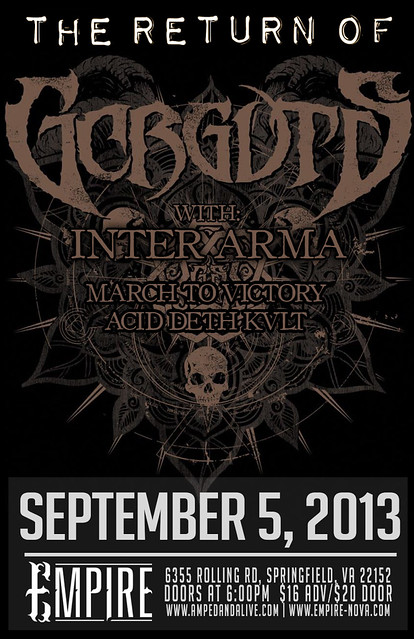
The French Canadian death metal band Gorguts is coming to Empire (formerly Jaxx) in Springfield, Virginia on Thursday, September 5th! They haven’t played the area since reforming and one of you lucky readers will win a free pair of tickets to the show. To enter just leave a comment on this post telling me which old school metal band you hope reforms to make a come back next and at 5pm EST this Friday, August 30th, a winner will be chosen at random (using Random.org) from all valid entries to win the tickets. Be sure to use a valid email you check regularly so I can contact you if you win. Don’t worry, I won’t add you to any spam lists or sell your info or anything sleazy like that. If you can’t wait to see if you win or the contest is already over when you read this, then you can get tickets from Amped & Alive for $16 here.

In the 90s Gorguts put out some excellent technical, yet very brutal, death metal albums but ended up going on hiatus in the new millennium. They reformed to play a set at Maryland Deathfest in 2010 which was awesome but lacked any new material. Well the new Gorguts album Colored Sands is coming out and I can tell you that having heard an advance copy already, it’s sick. This isn’t a recreation of past glories, this is a modern evolution of the classic Gorguts sound and there’s even some surprises in there too. If getting to see Gorguts play their classic songs plus some of their killer new material live wasn’t great enough there’s also direct support coming from Richmond’s Inter Arma. They released their first album on Relapse earlier this year and have been putting on some outstanding live performances in support of it. Seriously, catch these guys live and you’ll become a fan. There will also be sets by March To Victory from Pennsylvania and locals Acid Deth Kvlt. Now check out these awesome new songs by Gorguts and Inter Arma as you decide which old school metal band you wish would come back next!

Listen To Nightmonger by Midnight Eye

Local metal band Midnight Eye is releasing their EP Nightmonger and they kick off their tour supporting it with a free show this Thursday, August 8th, at The Pinch in the Columbia Heights neighborhood in Washington DC (details here). Stream the EP above, pick it up on Bandcamp here and be sure to come out Thursday to watch these guitar wizards pull this stuff off live. And while you’re listening to Nightmonger, check out the review of it below by new DCHM writer Tal (you can find more of her writing on her regular blog here).

Band: Midnight Eye
Album: Nightmonger
Release Date: 8 August 2013
Buy From Bandcamp for $4: Here

Cover of Nightmonger by Midnight Eye

Midnight Eye further develops their distinctive sound with their 3-song EP Nightmonger. The new release keeps the energetic heavy metal/thrash groundwork that they laid in their first album, Sign, but also takes a few steps further in the progressive direction, with unusual vocals as well as widely varying guitar passages. But these guys have the guitar chops to tackle all the different styles they want to pursue, and piece them together fairly cohesively.

Rocking NWOBHM riffs just on the verge of thrashy form the base of their sound, occasionally taking off into a full-out frenzy-inducing thrash whirlwind. Along with shreddy guitar solos, there’s also a lot more noodling compared to the first album and even a low-tempo acoustic passage in the second song, “Chaos.” The change of pace when the acoustic segment begins is a little jarring, but it doesn’t utterly destroy the energy of the song. The bass and drums soon come back in to give the instrumental some thrash kick, and after the lead guitars meander for a bit, they finish the song with a speeded up version of the main riff, giving it a satisfying conclusion. Missing from the EP are the doomy segments that haunted a couple songs from the first album, but the third song, “Outsider,” features some buzzsaw black metal riffs instead. The end of this song, which really picks up the black metal sound with insistent drums and sweeping tremolo riffs, is one of my favorite moments on the EP.

While the guitars have immediate appeal, the vocals take some getting used to. The tone of the mid-range clean vocals, which dominate Sign, is unusual, although it sounds sort of like a mid-range take on early King Diamond. Nightmonger showcases a lot more of Simon Callahan’s ability to generate King Diamond-like shrieks and high-pitched notes, especially in the second song, “Chaos.” I’m still not quite sure if their attempt to combine the shrieks and clean vocals works in that song, but I do prefer the high-pitched vocals to the mid-range ones overall.

I enjoyed staring at the simple and yet intricate cover design for a while. It reflects the band’s carefully executed complexity, and hints at the black metal touches in their music. The depth of their lyrics also matches the complexity of the band’s sound. I enjoy lyrics that are a bit poetic, rather than obvious and straightforward. While the chorus of the first song is pretty direct – “people cling to these very truths:/they love their nation/before other nations/they love their friends/not others” – the verses are more subtle. This song is apparently based on the Chinese philosophical text Zhuangzi, which espouses harmony with the natural way of things, so the nature images in the verses are a fitting touch. The ending of the song – “sound the alarm/tell everyone/there’s no purpose/to anything at all” – at first seems like an abrupt break with the theme of waxing and waning concern for others. Chinese philosophical anecdotes often end with a lesson, though, and looking at it that way, the lesson in the last verse is that human attachments are so changeable that there’s really no purpose in pursuing them. The other two songs, while not as cryptic, are also nicely constructed, using images and metaphors to propel their message of distrust of those in power. I particularly like the phrase, “outsiders,/from shades of grey/are made in the/gears of the world,” from the third song, “Outsider.” It reflects a penetrating awareness of how otherness is constructed and used by the majority.

I’m enjoying the EP more with each listen, and looking forward to hearing the band play it live. Midnight Eye is holding a release party this Thursday, supported by Exar Kun and Thrain, so don’t miss the chance to see these stellar guitarists live. I’ll be there pushing people around when the thrashy parts take off!